Guam Gains Defender Independence in Unanimous Bipartisan Win
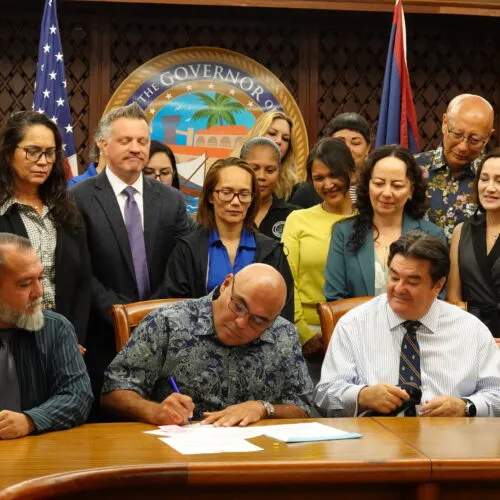
Pleading the Sixth: Guam gets the job done on much needed reforms thanks to strong bipartisan leadership from all three branches of government. With Acting Governor Josh Tenorio signing 97-38(LS) into law on August 18, 2025, a new independent board with standard-setting authority will now oversee all right to counsel services on Guam. Guam’s leaders worked swiftly to fix the pervasive judicial interference detailed in 6AC’s March 2024 report because, as explained by Guam Supreme Court Chief Justice Robert J. Torres, Jr., “public trust is strengthened when the defense function operates independently – free from influence or overreach of any one branch of government.”
On August 18, 2025, Acting Governor Josh Tenorio signed into law the Guam Public Defender Service Corporation Act of 2025 (Act) with unanimous bipartisan support from the Guam Legislature and leadership from the Guam Judiciary. This marks a significant turning point for Guam’s indigent defense system. The Act grants a new independent board with full oversight authority over all right to counsel services on Guam, improving the system so that it is better aligned with U.S. Supreme Court caselaw and national standards. We congratulate Guam government leaders for responding swiftly to 6AC’s March 2024 report by addressing all the report’s recommendations and securing a huge win for the people of Guam.
What the Act achieves: a before and after
Guam provides indigent defense services through government-employed public defenders of the Public Defender Service Corporation (PDSC) and private attorneys appointed by the court on a case-by-case basis.
Prior to the passage of the Act, PDSC was overseen by a five-member Board of Trustees: the Guam supreme court chief justice was the chair and appointed two members, and the Guam superior court presiding judge (who regularly presides over appointed cases in the trial court) was the vice-chair. Private attorneys were appointed on a case-by-case basis by the court from a panel overseen by a separate five-member standing committee: the Guam supreme court chief justice appointed four members on the committee and the PDSC executive director was the fifth member. Furthermore, the court was allowed to appoint any active member of the Guam Bar Association. This structure heavily relied on judges to oversee and administer services, and the system was permeated with undue judicial influence, which is a problem. As emphasized by the U.S. Supreme Court, independence of appointed counsel is an “indispensable element” of “effective representation.”
“Public trust is strengthened when the defense function operates independently—free from the influence or overreach of any one branch of government.”
Chief Justice Robert J. Torres Jr.
The Act addresses government interference by changing the makeup of the board. As Guam Supreme Court Chief Justice Robert J. Torres Jr.’s stated in his legislative testimony: “public trust is strengthened when the defense function operates independently—free from the influence or overreach of any one branch of government.” The Board of Trustees will now be an independent seven-member board composed of two appointments each by all three branches of government and the seventh appointment by the Guam Bar Association President. The Act also empowers this new independent board with the authority to select the PDSC Executive Director and to oversee, supervise, administer and budget all indigent representation services, including private attorneys.
Another significant improvement made by the Act deals with the mechanics of oversight – the authority to set and enforce standards island-wide. As Acting Governor Josh Tenorio stated during the bill signing ceremony: “The new structure of the public defender system allows the agency to develop the standards necessary to allow the attorneys of the public defender offices to have the time and resources necessary to properly represent their clients. Effective representation means more than simply having a licensed attorney sitting with you during court proceedings. It requires providing the attorneys the time to properly prepare and access the resources needed to prepare their cases.” The Act grants authority to the new independent board to collect data and establish formal standards on indigency determination, attorney workloads, attorney training and experience, attorney compensation, the early appointment of counsel, and more. This new framework will enable government to meet constitutional standards and provide attorneys with sufficient time and resources to effectively represent every indigent person.
“Effective representation means more than simply having a licensed attorney sitting with you during court proceedings. It requires providing the attorneys the time to properly prepare and access the resources needed to prepare their cases.”
Acting Governor Josh Tenorio
An all-hands-on-deck effort
Achieving reform is no easy feat; it requires the will to take a hard look at system deficiencies, cooperation from various stakeholders, and a commitment to meet the Sixth Amendment’s constitutional mandate. Leaders from all three branches of Guam’s government demonstrated they had what was required to achieve reform, to care for their community, and take seriously the rights of their people. They recognized the need for change, as reflected by Republican Senator Frank F. Blas, Jr., Speaker of the Guam Legislature, who affirmed during a legislative hearing that “access to competent legal counsel is not a luxury, it is a constitutional guarantee, and where the system falters it is our duty to intervene to reinforce the foundations of justice.”
“Access to competent legal counsel is not a luxury, it is a constitutional guarantee, and where the system falters it is our duty to intervene to reinforce the foundations of justice.”
Senator Frank F. Blas, Jr.
With this as a guiding principle, the bill passed with unanimous bipartisan support by the Guam Legislature. Guam stands out as a model for how government leadership can tackle the challenge to meet its constitutional obligation and secure the right to counsel. The Act, which goes into effect on October 1, 2025, creates a firm foundation for Guam to operate an independent right to counsel system.